
Start a Harrison County Property Search
A solid Harrison County property search runs from identification to proof. Start at the Beacon search linked to the PVA. Address, owner name, Parcel ID, or Alternate ID all work. Copy the parcel identifier and the owner spelling exactly. Then take both to the County Clerk's recorded-document system. That is where you find the deed. The deed put the named grantee in the chain of title. Tax and map systems answer different questions. No single result should carry all four.
The sequence also builds in a fallback. A road name, trust, or estate may fail to match. The pieces still cover for each other. The PVA handles E911 addressing and can confirm a standardized situs address. Clerk staff can pull an instrument when an account or date range blocks the way. GIS adds visual context. The recorded plat and deed carry the legal description. Each source holds a narrow, useful job.
- Search the PVA parcel roll by street address, owner, or parcel identifier.
- Copy the ownership spelling, situs, mailing address, map number, and assessed-value fields.
- Search that owner as grantee or party in the Clerk's eCCLIX index.
- Compare the parcel shape with county GIS and any recorded plat reference.
- Ask the custodian for the full image, certified copy, or material not online.
The Harrison County property search page holds the deeper mechanics. It explains how to recover when an address query fails. Note: Assessment, deed, and tax systems update on separate schedules, so record your date of access.
Offices Behind Harrison County Records
Three local custodians divide the core work. The PVA maintains the assessment roll, parcel identity, characteristics, exemptions, and value. The Clerk records deeds, mortgages, liens, releases, and plats. The Sheriff collects current property taxes, and unpaid bills later move to the Clerk as certificates of delinquency. Call the office that owns the record.
Harrison County Clerk
111 South Main Street, Suite 102
Cynthiana, KY 41031
859-234-7130; Deed Room 859-235-0513
Harrison County PVA
111 South Main Street, Suite 101
Cynthiana, KY 41031
859-234-7133
Harrison County Sheriff
113 West Pike Street
Cynthiana, KY 41031
859-234-7135
Read the Harrison PVA Card
The PVA parcel card indexes a current tract. Expect Parcel and Alternate ID, situs address, Ownership, mailing address, city, area, and assessed value. Reference fields, land and building traits, exemptions, and any transfer clue round it out. Beacon gates the live card. Confirm owners and values on the live card.
| Card field | Useful reading | Important limit |
|---|---|---|
| Ownership or Owner | Assessment-roll owner of record | May trail a new deed |
| Situs address | Physical parcel location | May differ from postal wording |
| Mailing address | Destination for owner mail | Does not prove residence |
| Parcel or Alternate ID | Cross-reference for PVA and map work | Not always searchable in eCCLIX |
| Assessed value | Tax-roll valuation | Not a sale offer or appraisal |
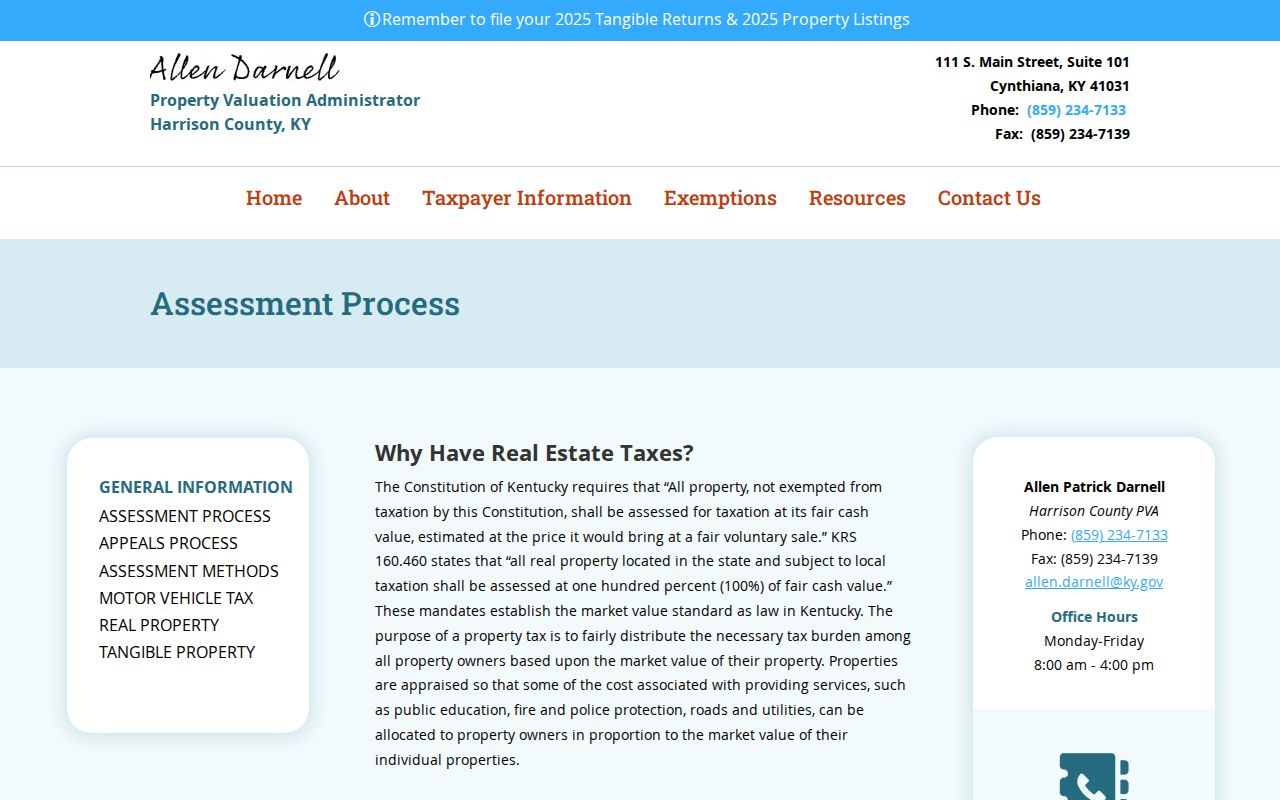
Parcel definition: A parcel is the assessment and mapping unit that gets an identifier. A lot, a tract, or combined land all fit inside one. Its tax-map outline is never a surveyed boundary. The Harrison County PVA assessment-process page explains how parcel facts feed the annual assessment. That cycle drives the bill.
Assessment, deeds, and tax payments are separate record layers.
Harrison Deeds Move Through eCCLIX
The County Clerk's online-records page routes searchers to eCCLIX. Harrison County's online records start January 1, 1985. Grantor, Grantee, Book/Page, and instrument-number searches all work. The exact Harrison filters sit behind the account interface. A grantor conveys an interest; a grantee receives it. Searching the current PVA owner as grantee is the cleanest bridge from parcel card to deed.
A private Harrison County resident may open a free personal account with five searches per day. Commercial access runs on a paid subscription. That difference matters when you plan a long chain. The Deed Room is the direct fallback for documents, book references, and older work. Published recording charges cover filing a new instrument, not the cost of copying an existing document.
For the full grantor-grantee method and deed types, use the Harrison County deed records resource. Note: eCCLIX is not a direct tax-lot search, so take the owner name from the PVA first.
Harrison County Property Record Types
Harrison County property records are not interchangeable. A deed documents a conveyance. A mortgage or lien records a claim. The assessment card supplies annual tax-roll facts, and the tax bill reflects collection. A plat depicts a recorded division, while planning files and ordinances explain zoning, annexation, or a street change without touching ownership.
| Record Type | What It Documents | Kept By | Access |
|---|---|---|---|
| Deeds | Parties, conveyance, legal description, recording reference | County Clerk | eCCLIX or Deed Room |
| Mortgages and liens | Secured claims, assignments, releases, notices | County Clerk | eCCLIX or Deed Room |
| Assessment and tax | Owner field, property traits, value, bill status | PVA and Sheriff | Beacon, office, tax link |
| Plats and parcels | Lot, block, tract, geometry, map context | Clerk and county GIS | Viewer, recorded image, counter |
| Planning records | Zoning, annexation, street or subdivision actions | Joint Planning and city clerks | Request by address or application |
The question selects the record. Use deeds for title events, the PVA for current roll data, the Sheriff for the current bill, and the Clerk for delinquent certificates. Plats and surveys supply boundary evidence. A planning ordinance can explain why a place sits inside Cynthiana, yet the deed still controls the title event.
Limits of Harrison County Property Records
Official records do a lot. They identify a parcel, show the assessment owner, document conveyances, reveal recorded encumbrances, list assessed value, and place a tract on the map. They have limits, too. No system can guarantee every private claim was recorded, settle a boundary dispute, uncover every beneficial interest behind a trust, or promise that a value equals a sale price. Mailing and situs addresses answer different questions.
Lawful use. Harrison County property records support purchase research, estate work, boundary questions, tax review, and civic transparency. A record search is not a title opinion or survey, and owner information must never be used to stalk, harass, or harm a person.
Map Harrison Parcels With Care
The Harrison County GIS viewer is the place to see parcel shapes, roads, and neighboring tracts. The county publishes no detailed list of its live layers, selection tools, or export options. Treat those features as unknown until you see them in the viewer itself. Statewide KyGovMaps adds aerial, elevation, topographic, and boundary context when the county shell falls short.
Map lines are reference graphics only. Match any shape against the legal description and the Clerk's recorded plat. That habit matters most around roads, creeks, rural acreage, and subdivision changes. White Oak Estates records, for instance, trace through a cabinet and sheet citation. A deed-book reference comes with it. The county map supplies only the visual setting for that work.
Separate Current and Delinquent Taxes
The Harrison County Sheriff runs the current tax-bill search and collection. The PVA sets the assessment data behind each bill. Under Kentucky's normal collection path, unpaid bills move to the County Clerk after April 15 and become certificates of delinquency. The Clerk then manages the delinquent-tax record and sale. A bill shows the obligation, district, and payment status. It is not a deed.
One caution belongs here. The Clerk's delinquent-tax page has carried stale sale notices before, describing an event that had already passed. Check the live page for a fresh list instead of trusting an old notice. That small check saves real confusion in Harrison County property research.
Protect Harrison Names With DOC ALERT
The Clerk's DOC ALERT service sends a free email whenever a deed or mortgage is recorded. The instrument must bear a registered personal or business name. It is a monitoring tool, not a deed search and not a fraud guarantee. Register every spelling variant that matters, especially for businesses. When an alert arrives, review the indexed instrument. Call the Clerk if the filing is unfamiliar. Confirm the owner spelling in the deed and PVA card first. Trust names, initials, entity suffixes, and punctuation can all affect matching. The service does not track parcel events by map number.
Harrison Records Begin in 1794
Harrison County formed from Bourbon and Scott Counties in 1794. The Kentucky Department for Libraries and Archives inventory lists Harrison deeds beginning in 1794. It also lists wills in 1795. County order and civil-case books start in 1796. The Clerk's online cutoff sits at 1985. That marks a change of access channel, not the start of the records.
Older land work can move through the Deed Room. KDLA guides and inventories also help. FamilySearch catalogs offer another path. KDLA also holds historic tax-assessment book runs with gaps and plats on 1877 microfiche. A negative online result means "not found in this index and date span." It never means "no record exists."
The Cynthiana-Harrison County Public Library Kentucky Room adds local context. It holds The Log Cabin microfilm from January 1896 through September 1960, plus a digitized archive for library-computer use. Newspapers can surface estate sales, tax notices, subdivision names, and old road descriptions. Verify against the deed or government book itself.
Use Kentucky Open Records
When a portal blocks access, send a focused request instead. Target the office that keeps the record. Kentucky's Open Records Act process, KRS 61.870 through 61.884, covers requests to public agencies. Name the record type first. Add the party or parcel, approximate date, and any book, page, instrument, or case number you already have. Ask for an electronic format when that helps.
Route each request to the right office. A deed belongs with the County Clerk and Deed Room. Assessment fields and E911 address help come from the PVA. A current bill belongs with the Sheriff. A delinquent certificate belongs with the Clerk. Historical copies held by KDLA use a separate request schedule. Those may take four to six weeks. One broad request to the wrong office adds delay without broadening access.
Note: A precise request for an existing record beats one asking an agency to conduct open-ended research.
Keep the request narrow enough to route. A party name plus a deed date goes to the Clerk. A parcel identifier and assessment year go to the PVA. A bill number and payment question go to the Sheriff. Some matters need the courts. An estate, lawsuit, or quiet-title action sends you to the Harrison Circuit Court Clerk. Use the Kentucky court index only to identify the case. Then request the local file from the court custodian. Clear identifiers help each Harrison County office return the right record.