
What Harrison County Property Tax Records Show
Three offices divide the work in Harrison County. The Property Valuation Administrator sets the assessment and exemption information. The Sheriff collects the current bill. The County Clerk takes over when an unpaid bill becomes a certificate of delinquency, so a complete property search follows the parcel across all three stages rather than trusting one screen to explain everything.
| Field | What it answers | Where to verify it |
|---|---|---|
| Parcel / Alternate ID | Which taxable unit the record concerns | PVA Beacon card |
| ASV | The value entered on the assessment roll | PVA |
| Owner / Ownership | The assessment roll's owner label | PVA, then newest deed |
| Tax year and districts | Which year's rates apply | Sheriff bill |
| Payment status | Current, discounted, delinquent, or transferred | Sheriff or Clerk |
| Certificate of delinquency | An unpaid bill transferred as a lien | County Clerk |
Harrison Assessment and Collection Are Separate
The Harrison County PVA assesses real property under Kentucky's fair-cash-value standard. The Harrison County Sheriff collects current county property taxes from its office at 113 West Pike Street in Cynthiana and posts a Search Property Taxes service online. Delinquent bills are different. After the statutory transfer date they belong to the Harrison County Clerk, which handles delinquent certificates and the annual sale process. This split trips up many searches. The current bill sits with the Sheriff. An older unpaid obligation may already have moved to the Clerk, and the assessment card alone will never confirm whether payment was made.
Look Up a Harrison County Tax Bill
- Search the known address in the PVA's Beacon application.
- Copy the Parcel or Alternate ID exactly and record the owner label and ASV.
- Open the Sheriff's tax search and match the identifier, tax year, and property description.
- Read the bill for taxing districts, discount or penalty period, and payment status.
- If an older bill is absent, ask the Clerk for the existing bill or certificate by parcel, year, and bill number.
- Fair cash value
- The voluntary-sale standard Kentucky applies to assessment.
- Taxing district
- A jurisdiction whose rate contributes to a parcel's bill.
- Certificate of delinquency
- An unpaid bill transferred to the Clerk and treated as a lien.
Note: A mortgage company may receive an escrowed bill, so the bill recipient need not match the PVA mailing address. Check with the Sheriff before assuming a bill went unpaid.
Search Harrison's Assessment Card by the Strongest Key
Beacon offers Search All, Name, Address, Parcel ID, and Alternate ID modes. An address is the easiest starting point. Switch to the parcel identifier when rural addressing, road-name variants, or city labels blur the match.
| Search mode | Input | Practical use |
|---|---|---|
| Address | Street number and road | Find a familiar property |
| Name | Surname or entity name | Find an assessment by owner label |
| Parcel ID | Exact identifier | Match assessment to bill |
| Alternate ID | Secondary card identifier | Cross-reference older material |
Headings such as Parcel, Alternate ID, Address, Ownership, City, Area, State, ASV, Ref Num, and STR label the fields. The exact Harrison result controls. Fill in nothing the record leaves blank.
How the Harrison PVA Reaches a Value
The PVA describes three ways to reach a value. Sales comparison adjusts relevant sales, a natural fit for houses, vacant land, and farms. The cost approach estimates replacement cost, subtracts depreciation, and adds land value. Income capitalization weighs expected income and expenses for income-producing property. Each method supports fair cash value. None of them means an assessment must equal the price in a particular deed. Kentucky revalues real property annually, considers new construction each year, and requires the PVA to physically examine property at least once every four years, so that cycle is a review rhythm rather than a freeze.
Read Harrison's Published Rates by District
The PVA's 2025 table breaks rates out by district, with state, county, school, library, health, extension, soil-conservation, fire, and city lines each listed separately. The county real-estate total reads 104.9000 per $1,000. That figure is not a universal parcel calculation. Cynthiana and Berry residents do not carry the county fire-district charge in the same way, and the in-city rows are easy to misread. Use the parcel's current bill instead. Its taxing-district designation governs the math. A copied rate table cannot account for every exemption, discount, penalty, or later rate change.
Harrison Homestead and Disability Evidence
The PVA's exemption guidance starts with one rule: own and maintain the property as a personal residence on January 1. Proof varies by category. Age-based applicants may use Medicare documentation, a birth certificate, or a driver's license. Disability applicants face a stricter test. They must be totally disabled under a qualifying federal or retirement program. They must also actually receive payments. Common proof includes Social Security, SSI, VA, TVA, and teacher-retirement records. The official page carries the application route and the full proof categories.
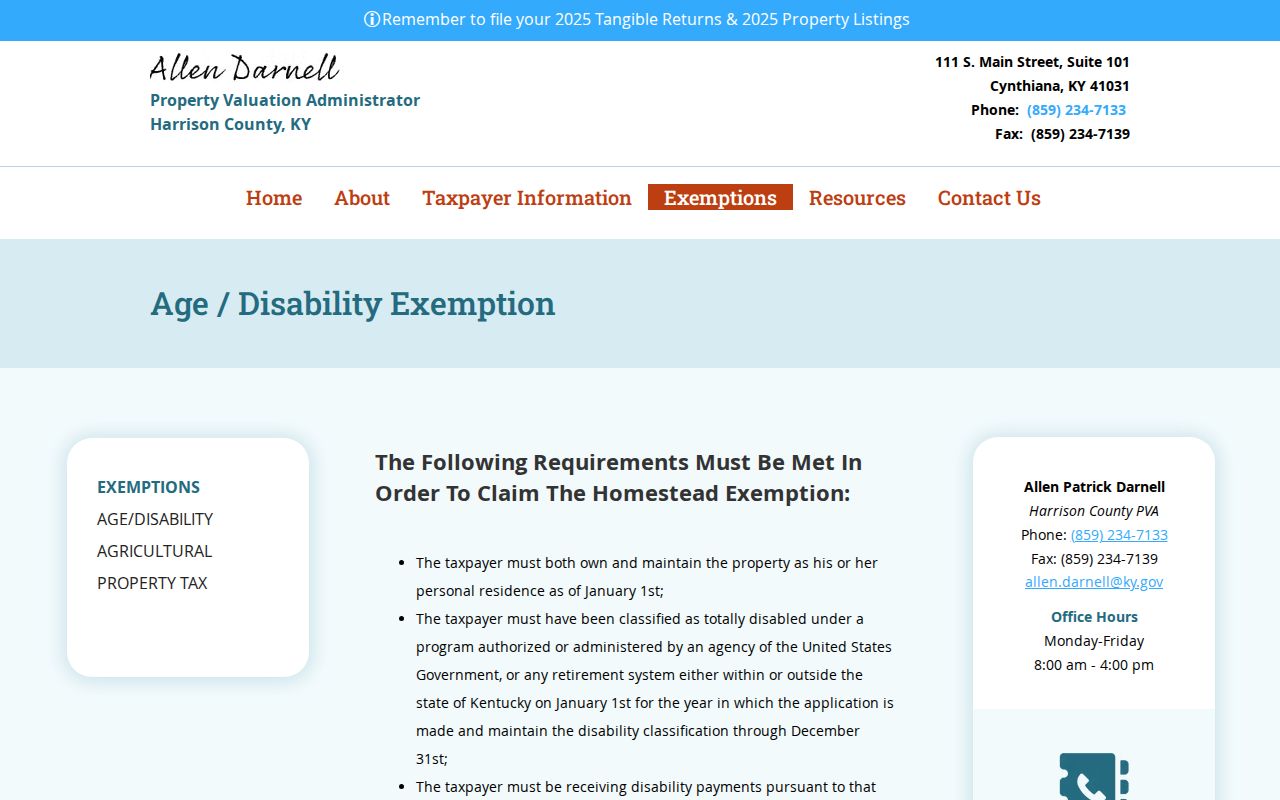
Eligibility documents and forms change, so current instructions control. The form asks about prior homestead use elsewhere, ownership date, relationship to another owner, and unit type. Call the PVA at 859-234-7133 for the current form. Never infer exemption status from a low bill.
Use Harrison's May Review and Appeal Window
The PVA tax calendar anchors everything to January 1, the assessment date. Real-estate listing runs January 1 through March 1. Inspection follows in May. The assessment roll opens for 13 days beginning the first Monday in May, six days a week including Saturday. The Board of Assessment Appeals period lasts five days and begins 25 to 35 days after inspection closes. That spacing keeps listing, inspection, appeal, and collection distinct.
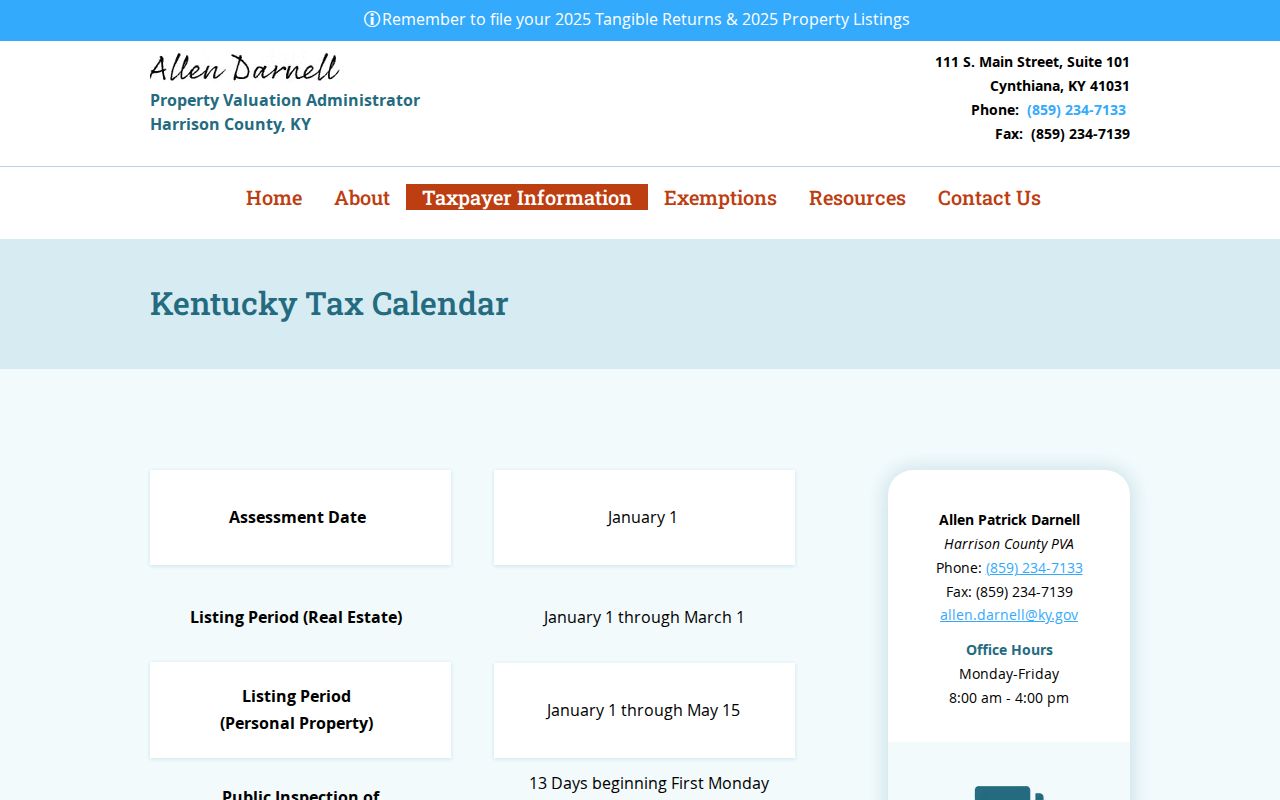
Recheck the live calendar first. Dates shift each year. When you review the card with the PVA, bring parcel-specific evidence such as measurements, photographs, comparable sales, or an appraisal, and follow the Board's current published procedure if the issue remains unresolved.
Deadline control. The appeal dates are calendar-dependent; check the current PVA calendar rather than assuming a permanent date.
Follow the Harrison Bill from Fall to Delinquency
Real-estate bills generally go out after September 15. Payment earns a discount through November 1. Face amount runs November 2 through December 31. Delinquency begins January 1. A 5% penalty arrives in January. After January 31 the penalty grows and a Sheriff fee applies. State and county descriptions summarize these later additions differently, so the printed bill and current Sheriff instructions control. At close of business on April 15, unpaid bills transfer to the Clerk, where interest runs at 1% per month under state guidance and Clerk and county-attorney fees may apply. The certificate is a lien, and buying or paying it does not by itself convey the parcel.
A Dated Harrison Tax Sale Is Not a Standing Auction
Sale notices go stale fast. A Harrison County Clerk certificate sale notice described an August 21, 2026 sale with an August 11 registration deadline. Both of those dates come and go within weeks. Always check the year and the posted update date on any sale list. Do not treat an indexed PDF as the next scheduled event.
A good sale-list row carries real substance. It should show the taxpayer name, the bill number, a map or parcel ID, and the total amount due. Status can shift after the list is built. Payment, assignment, or litigation may each change the record. So confirm with the Clerk before relying on any single entry.
Request a Missing Harrison Roll or Bill
The Harrison County Clerk's sale page showed a certificate sale set for August 21, 2026. Registration closed August 11. Both dates had already passed, yet the list still sat online as a PDF. Check the year and the update date on every sale list. An indexed document is not the next event. Sale notices age fast.
A good sale-list row carries the taxpayer name, bill number, map or parcel ID, and total due. Confirm status with the Clerk before relying on any entry. Payment, assignment, or litigation can change the record after the list is posted.
What Harrison Property Tax Records Cannot Prove
Each document answers one question. The PVA card shows the assessment entry. A tax bill shows what a parcel was charged and whether it was paid. A delinquent certificate proves a tax lien exists. What none of them can do is establish fee-simple ownership, fix a legal boundary, or guarantee market value. For those answers, pull the newest recorded deed, compare deeds and plats with a survey when boundaries matter, and bring value questions to the PVA or a qualified appraiser.