
Compare Harrison County Property Value Figures
A single parcel can carry several numbers. Each one answers a different question. The Property Valuation Administrator supplies the assessment the tax system uses, a recorded deed may state what a transfer actually paid, and a private appraisal estimates value for one date and one purpose. Swapping them freely is a mistake. Treating these figures as interchangeable is the fastest way to misread a Harrison County property record.
| Recorded figure | Meaning | Official source |
|---|---|---|
| Assessed value (ASV) | The tax-roll value under Kentucky's fair-cash-value standard | Harrison County PVA / Beacon |
| Fair cash value | The price a willing buyer and seller would agree upon in a voluntary sale | PVA valuation methodology |
| Recorded consideration | An amount or consideration stated in a deed, when disclosed | County Clerk deed image |
| Tax bill | A year's assessment, rates, discounts, and penalties | Harrison County Sheriff |
| Exemption | A statutory reduction or exclusion reflected in assessment or tax | PVA |
Kentucky's standard is 100% fair cash value. A tax bill is still another number. It applies the parcel's taxing-district rates and any exemption to the assessment, so it can drift far from any sale price the standard never promised to match in the first place.
How Harrison Estimates Fair Cash Value
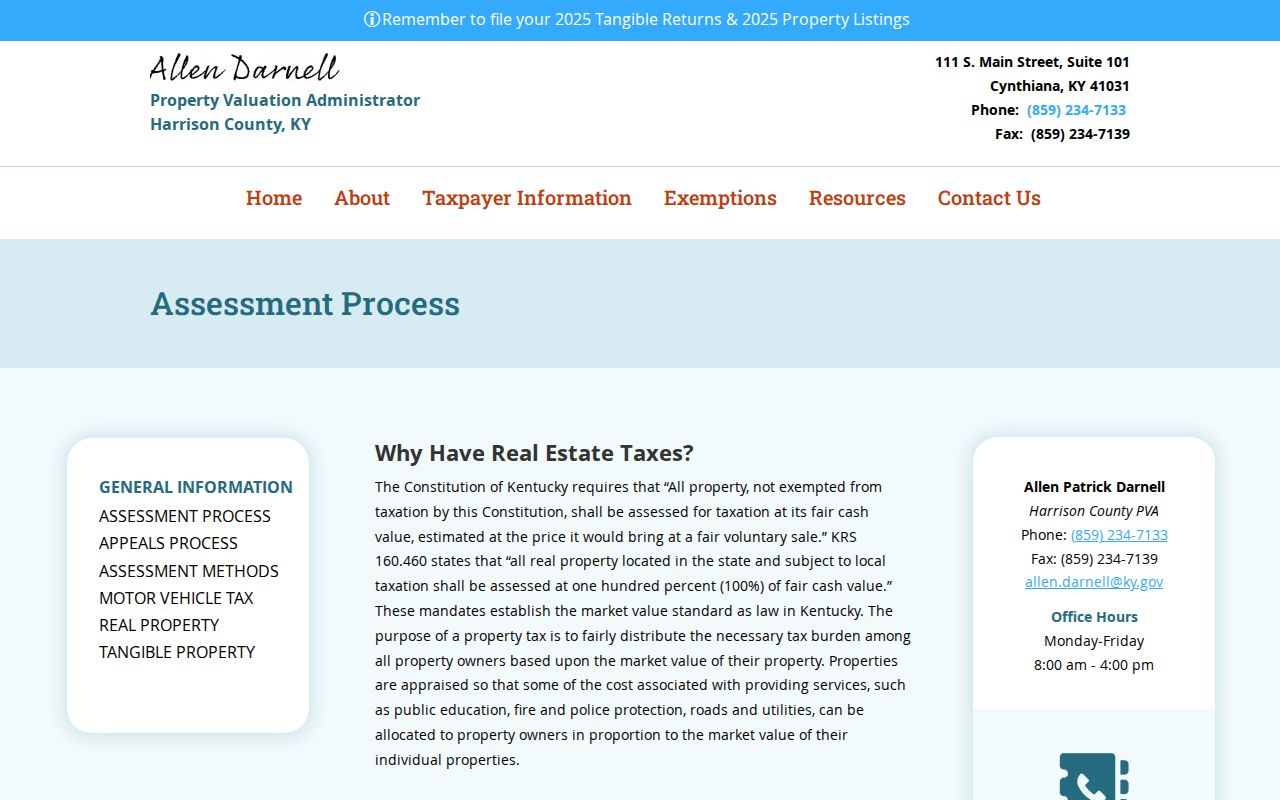
The PVA assessment process page lays out three recognized approaches. Sales comparison leads for homes. Comparable sales get adjusted for meaningful differences. Vacant land and farms use it too. The cost approach estimates replacement cost. It subtracts depreciation and adds land value. Income-producing property such as stores or factories is valued by capitalizing expected income and expenses.
The PVA's own page is the local source for that framework.
A countywide method never dictates one parcel's final figure.
Value is not a promise. A mass-appraisal assessment is an administrative estimate, not a guaranteed resale price or a parcel-specific private appraisal.
Look Up a Harrison County Property Value
The Harrison Beacon application is the place to start. Its public landing page offers search modes by name, address, Parcel ID, Alternate ID, and a combined search. Card layouts change over time. So follow the labels actually displayed instead of expecting one fixed template.
- Search the street address; if it fails, shorten it to the street number and road name.
- Open the matching parcel and copy its Parcel or Alternate ID exactly, preserving zeroes and punctuation.
- Record the Ownership field, assessment year, ASV, area, and any last-sale reference visible.
- Use the owner name or deed reference in the County Clerk index to check the newest recorded conveyance and any consideration.
- Assessed value
- The value entered on the tax roll.
- Situs
- The property's physical location, which can differ from the owner's mailing address.
- Recorded consideration
- The transaction figure stated in an instrument, when the deed discloses one.
Note: Record the assessment year beside every figure, because comparing values from different years without dates can suggest a trend that does not exist.
Read Harrison Beacon Search Modes Carefully
| Mode | Best starting input | Use |
|---|---|---|
| Name | Owner surname or exact entity | Find parcels associated with a recorded owner label |
| Address | Street number and name | Reach the value card from a known site |
| Parcel ID | Identifier copied exactly | Return to a specific tax parcel |
| Alternate ID | Second identifier from a card or bill | Cross-reference systems |
| Search All | A cautious combined query | Broaden an uncertain lookup |
Beacon's result headings run long. Columns include Parcel, Alternate ID, Address, Ownership, City, Area, State, ASV, Ref Num, and STR, which makes the tool practical for zeroing in on an assessment. None of that proves title.
Why a Harrison Property Value Changes
Values move more often than people expect. Kentucky Department of Revenue guidance revalues real property every year and considers new construction annually. Physical inspections come at least every four years. That interval does not freeze anything. Between inspections, values still change on paper.
Sales, a new structure, depreciation, an acreage correction, a parcel split or combination, or a recorded subdivision plat can each supply evidence for a changed card. Annexation and taxing-district changes can shift the bill even when the value holds steady. When a change surprises you, compare consecutive cards and pinpoint whether land, improvements, exemptions, or the district moved.
Find Harrison's Recorded Sale Figure
A value card and a deed answer different questions. The card estimates; the deed reports. Search eCCLIX using the owner name from Beacon, then find the newest deed by recording date, grantee, and book/page or instrument number. Open the image for stated consideration when access permits. Not every deed reflects an arm's-length sale, and some instruments offer no useful market comparison.
Family transfers, fiduciary deeds, correction deeds, and quitclaims may carry nominal or unrepresentative amounts. Keep the deed type beside the amount. For instruments predating the Clerk's January 1, 1985 online cutoff, the Deed Room and the Kentucky Department for Libraries and Archives are the fallback.
Do Not Reverse-Engineer Value from a Tax Bill
The PVA's published 2025 table separates state, county, school, library, health, extension, soil-conservation, fire, and city components. The layout invites misreading. Cynthiana and Berry parcels do not simply carry the county fire-district charge, so the in-city alignment is easy to get wrong. Skip the copied countywide total. Rely on the parcel's card, district, and printed bill. The Harrison County Sheriff collects the current bill. Unpaid bills later pass to the County Clerk as certificates of delinquency, and neither a paid bill nor a delinquent certificate proves ownership or market value.
Review a Harrison Assessment at the Right Time
Start with the assessment date: January 1. The PVA calendar builds the rest of the year around it. It opens the real-estate roll for public inspection over 13 days beginning the first Monday in May. Inspection runs six days a week. Saturday is included. A five-day Board of Assessment Appeals period begins 25 to 35 days after inspection closes. Talk with the PVA first. Bring parcel-specific evidence such as the card, photographs, measurements, relevant sales, or an appraisal. Unresolved issues go to the Board under the current year's dates.
Calendar matters. Appeal windows depend on the current year's published schedule; do not rely on a permanent month-and-day assumption.
Local Changes Are Clues, Not Valuations
Local events are clues, not valuations. Cynthiana annexation, rezoning, downtown grants, and infrastructure work all justify checking for a new district, plat, structure, or assessment entry. None of it proves nearby Harrison County values rose. One 2025 White Oak Estates notice shows how references work, citing Plat Cabinet 7 Sheet 222B and deed book 393 page 140. Those citations trace a parcel event. They do not assign a price, so treat local news as a prompt for record work rather than a valuation itself.
Limits of a Harrison County Assessor Value
An assessment from the Harrison County PVA is not an appraisal, survey, title opinion, or environmental report. Treat it as one data point. Because the county sets no fixed interval between a recorded deed and the tax roll, a value can lag the newest transfer at the Clerk's office. If the Ownership field conflicts with a recent deed, note both access dates, ask the PVA how its update works, and start from the most recent recorded transfer.
For a purchase or sale, the public record is a starting dataset. A survey settles legal lines. A title examination covers recorded interests, and an appraisal addresses market value for a stated effective date. Get the professional work the question actually needs.